Why can’t your body fully relax — even when you try?
A simple explanation of what may keep your nervous system in “alert mode” — and what to do next.
Even after rest, meditation, or time off, your body may still stay in a constant state of tension — and the reason is often misunderstood.
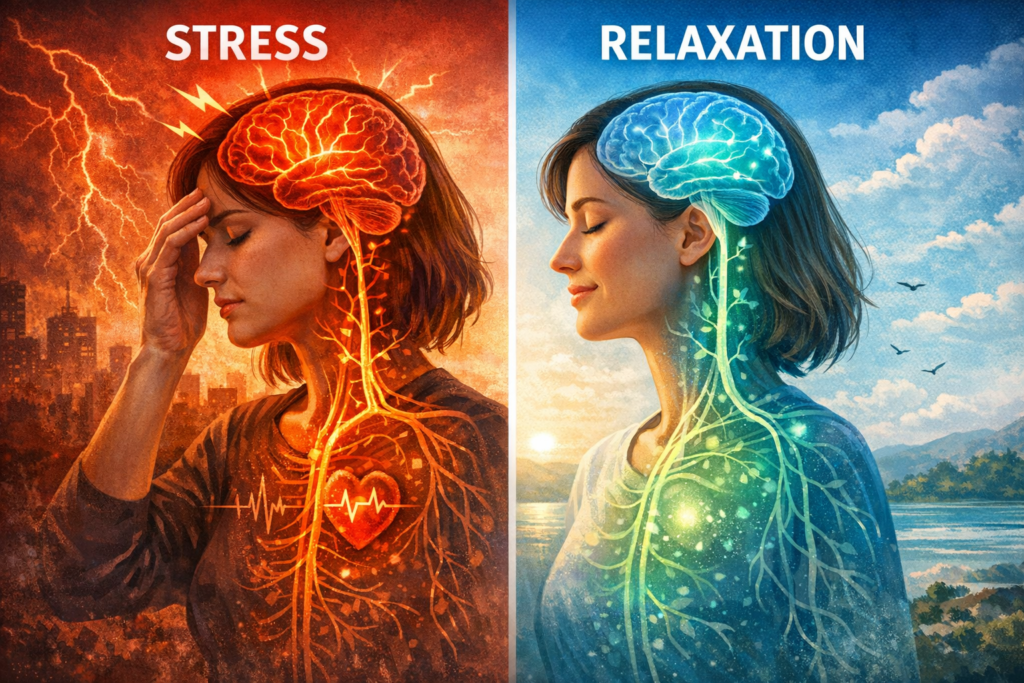
You may recognize this pattern:
- You feel tired, but not relaxed
- Your mind slows down, but your body stays tense
- Sleep doesn’t feel fully restorative
- Stress returns quickly, even after breaks
If this sounds familiar, you’re not alone — and it’s not a personal failure.
Stress isn’t just psychological
Most approaches focus on calming the mind. But stress is also a biological response.
When your nervous system remains in a heightened state, your body behaves as if it still needs to protect itself — even when no real threat exists.
Your nervous system controls relaxation
Your body constantly switches between two main states:
- Alert mode — focus, protection, survival
- Recovery mode — rest, repair, balance
Problems arise when the body struggles to return to recovery mode.
This helps explain why techniques that rely only on willpower, mindset, or distraction often bring limited or temporary relief.
What research has helped clarify
Neuroscience research suggests that genuine relaxation occurs when the body receives the correct physical and neurological signals — not only mental intention.
This insight has influenced how professionals think about stress regulation, recovery, and nervous system balance.
A more direct approach
Instead of forcing calm through effort alone, newer approaches focus on supporting the body’s natural relaxation response.
This perspective helps explain why some methods feel more effective — especially for people who have already tried common solutions without lasting success.
This content is educational only and does not provide medical advice.